
When I got the power supply, it appeared to be in pretty good shape. After carefully examining the supply, I decided it would probably be reasonable to rebuild the supply. The only thing which made it a bit more difficult was not being able to easily find replacement components with the same dimensions as the originals. With all of this, I decided not to stick with originality and go for functionality. At the same time, wiring in a relay to protect the power switch of what was being powered by the supply; in my case either a 32S-1 or KWM-2.
One thing I did discover was there are multiple schematics for the 516F-2 power supply. At least three of which I am aware, although one is in a service bulletin for conversion to solid state rectifiers. The supply I had did not agree with the schematic in the 32S-1 manual I had for my 32S-1 Transmitter, and was altually a later model. The only real differences are a couple of different component values in the bias circuitry and different transformer wiring colors.
Here are a couple of pictures of the chassis as I was cleaning it:


It was pretty obvious many of the caps were in need of replacement, and the locating pin of the 5U4 tube had broken off. In spite of all this, it did power up. But I really didn't trust it.
In addition, the Selenium rectifier had been bypassed with a silicon diode. (I'm assuming the rectifier was open because it was still in place, in the circuit.) I also discovered the ground braid of the multi-conductor cable was no longer of any real use. It was not completely broken, but only a couple of wired strands from the braid were gounded. Finally, the resonant cap for the choke had been removed.
So the first order of business was to completely strip down the chassis to determine exactly what parts could be reused and which parts were going to be replaced. In reality, I replaced all the passive components as well as some of the mechanical components. I am also fortunate to have obtained a fair amount of solid and multi-color PTFE (Teflon®) insulated hookup wire, so my new wiring doesn't look too much out of place.


The observant among you will notice I had also removed the holders for the original electrolytic caps. Some of the holes were reused for standoffs for the new circuit board with the new electrolytic caps.
Next were the transformer, chokes, and various mechanical bits:
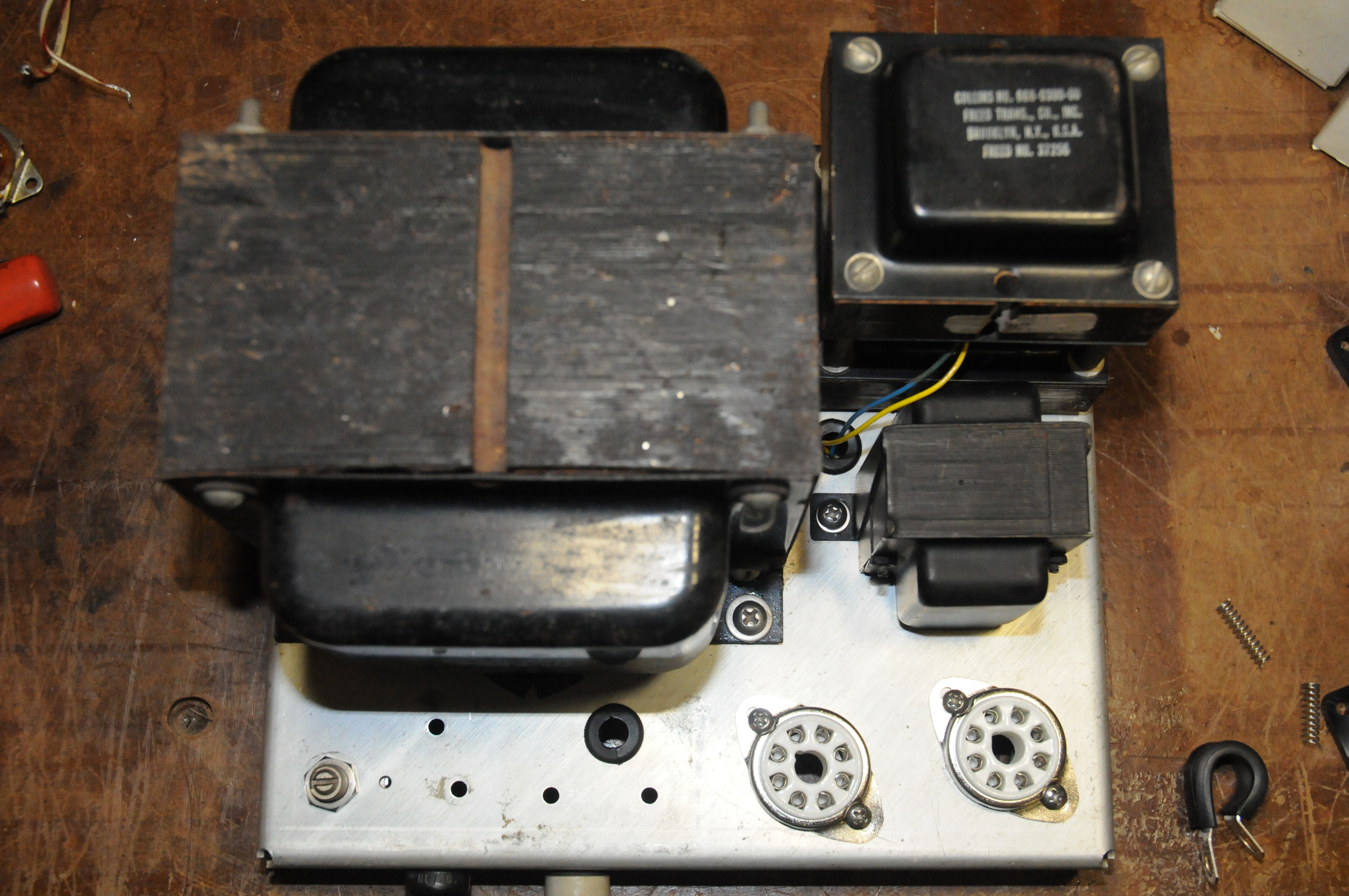

A couple of additions I made were to add grommeting material around the holes through which the transformer leads were passed and using ceramic tube sockets. I could not add grommeting to the one choke as there was not room between the chassis and the choke itself.
Rather than use point-to-point wiring for everything, I decided to use a small piece of printed circuit board with some Tektronix ceramic terminal strips installed for all the electrolytic caps. This was a borrowed idea.
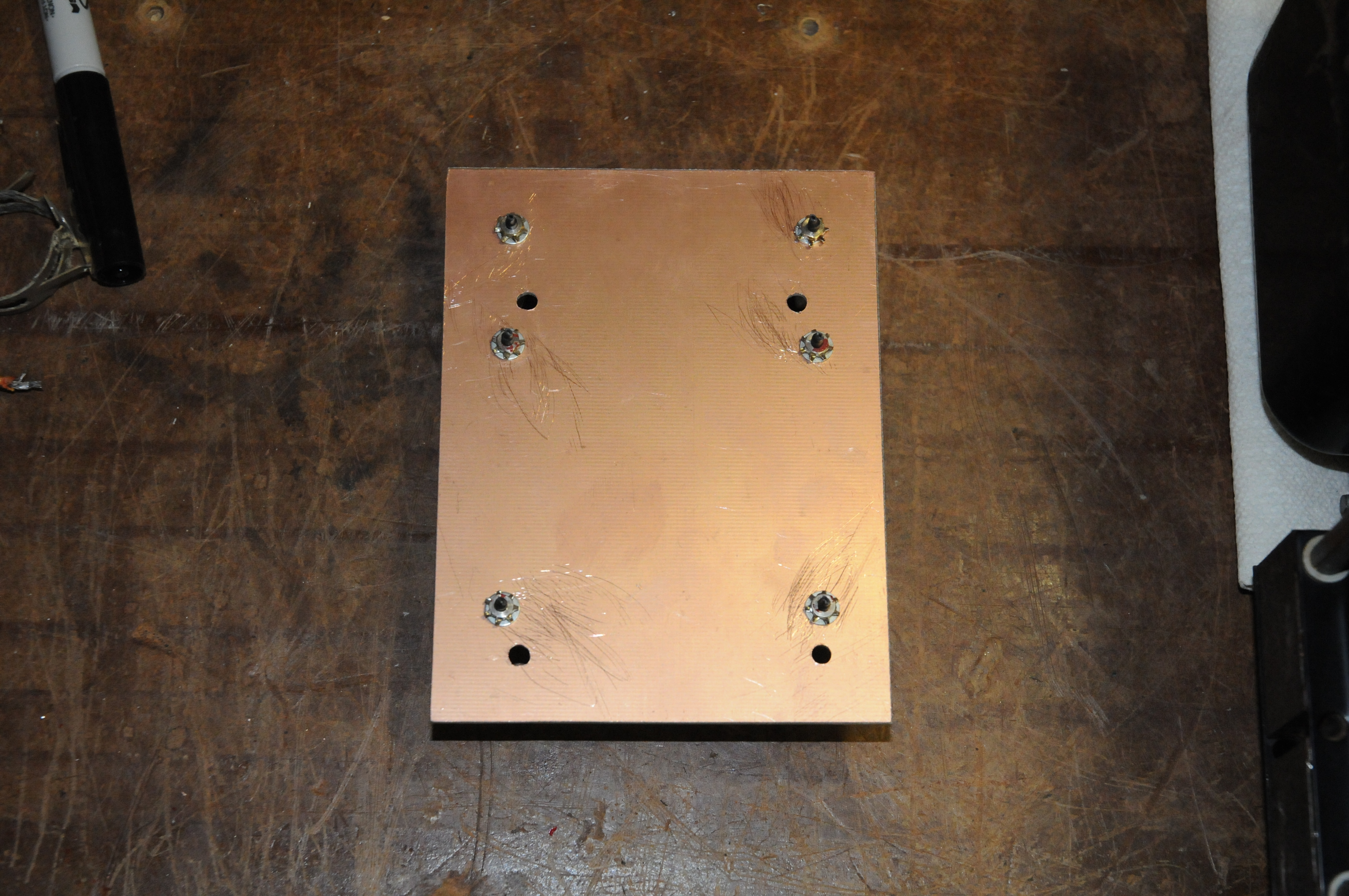

Because the bottom of the circuit board was copper clad, I used a file to chamfer the edges to make sure they were not sharp. I didn't want them cutting into the transformer leads passing underneath.
Unfortunately, in my hurry to get the supply rebuilt, I didn't take too many more picures. But here are some picures of the completed supply.


Later Collins 516F-2 Power Supply schematic from the KK5IM Technical Resource Website. (This site appears to be being rebuilt, and this link is broken.)
Using Textronix ceramic terminal strips in a Collins 526F-2 rebuild.
Service Information Letter 1-76: Prevent Fuse Blowing caused by arcing in the vacuum tube rectifiers
